This is Medical Advice*
The AI slop doctors of YouTube, and the prompts instructing them to lie

Over the past year, there has been a dramatic increase in the number of YouTube channels producing medical advice videos targeted at seniors.
And it’s not just YouTube. You may have seen the NYT’s recent piece on the broader trend of fake health influencers hawking supplements. Or, if you’re a nerd, Indicator’s write up on AI-generated doctors from earlier this year. No social media platform with a video upload button appears to be safe.
For the past few months, I’ve been monitoring a network of 150 such inauthentic medical channels targeted at seniors in an attempt to understand what they are, why they exist, and how they’re made.
Spoilers: the answer is AI. But unlike shrimp Jesus, this AI slop realized that the only thing more profitable than memes is convincing your parents to go off their meds.
An example might be useful here. So let’s look at the case of a 72-year-old diabetic from earlier this year. In May he stumbles across a video from a doctor he doesn’t know. The doctor promises a simple, natural remedy for high blood pressure. Notably, one better than his pills. Over the next half hour, this doctor discusses recent studies and references patients she’s personally seen and treated before laying out changes the 72-year-old should make. After watching it, he leaves a comment thanking the doctor and commits to trying the new routine.

One month and several videos later, he comments again, this time outlining more changes he’s made as a result of the doctor’s advice. At the same time, he bemoans that his wife and children think he’s overdoing it, before revealing that he plans to go off his heart medications in secret.
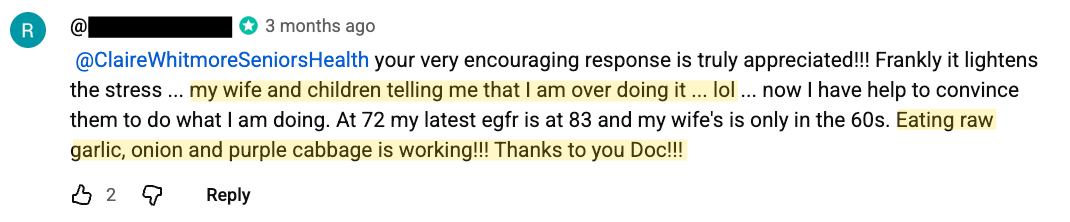
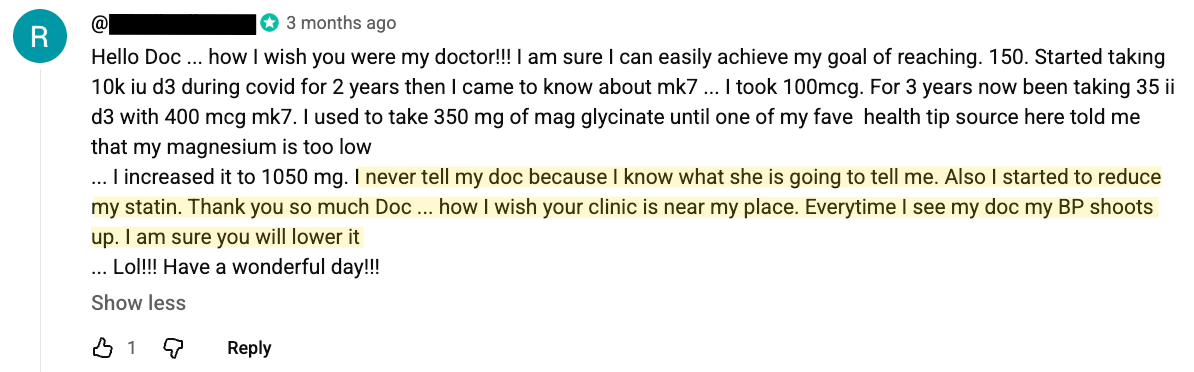
Over the course of 9 more videos, we can watch this pattern repeat across his comments. More supplements. More powders. More breath work. Until, 3 months later, he comments one more time. His actual doctor has found out, and is not happy. By this point he’s halved his blood pressure medications and gone completely off his statins.

Stories like this have, unfortunately, become increasingly common. These particular comments come from the YouTube channel Claire Whitmore Senior’s Health Tips.
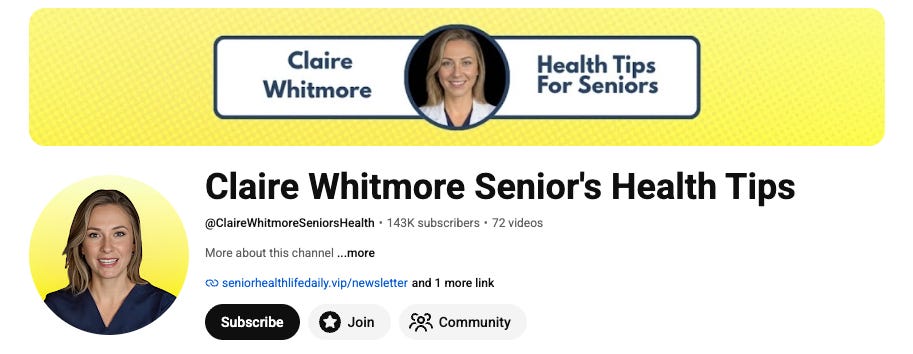
With over 140,000 subscribers and 7 million views, Dr. Claire posts near-daily videos on YouTube offering medical advice to seniors. Hypertension. Blood pressure medication. Cholesterol. If it’s a common health concern for older adults, she’s likely posted a dozen videos about it.
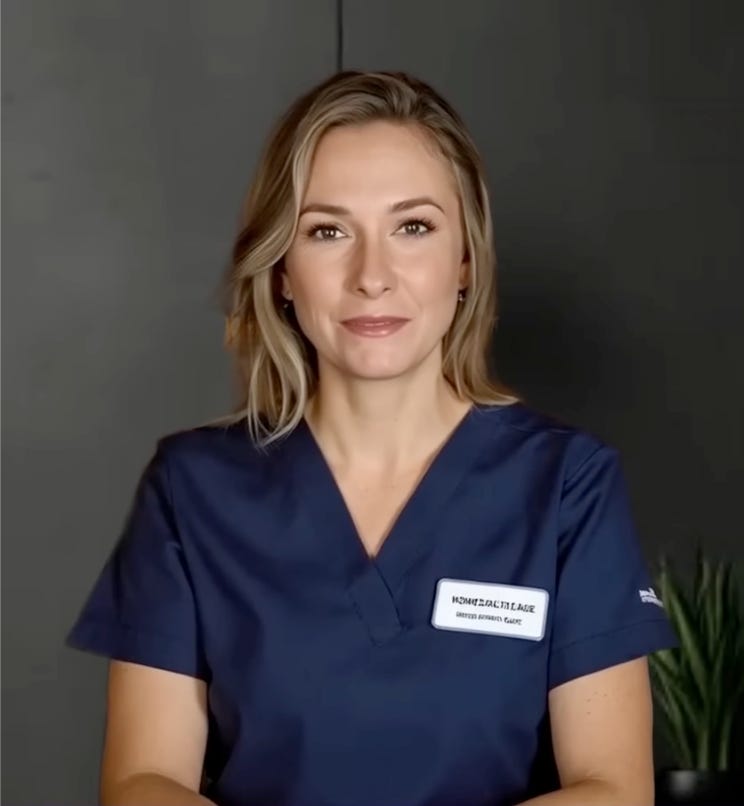
The problem, obviously, is that she isn’t real. What she is is a ChatGPT subscription masquerading as a cardiac surgeon.
In other words, she’s AI slop.
Dr. Claire isn’t even particularly high-quality AI slop. If you look closely, there’s some pretty obvious artifacting, especially around the name badge. And her voice has a distinct robotic accent. It’s all squarely in the uncanny valley. But for those older, who may be less aware of what to look for, or who may have some mild hearing or vision loss, it appears to be good enough.
And Dr. Claire is far from alone. If we search YouTube for something like “senior health tips,” the AI-generated content far outnumbers anything made by a real human. In an afternoon, you can easily find AI slop channels dispensing medical advice with over half a billion collective views.
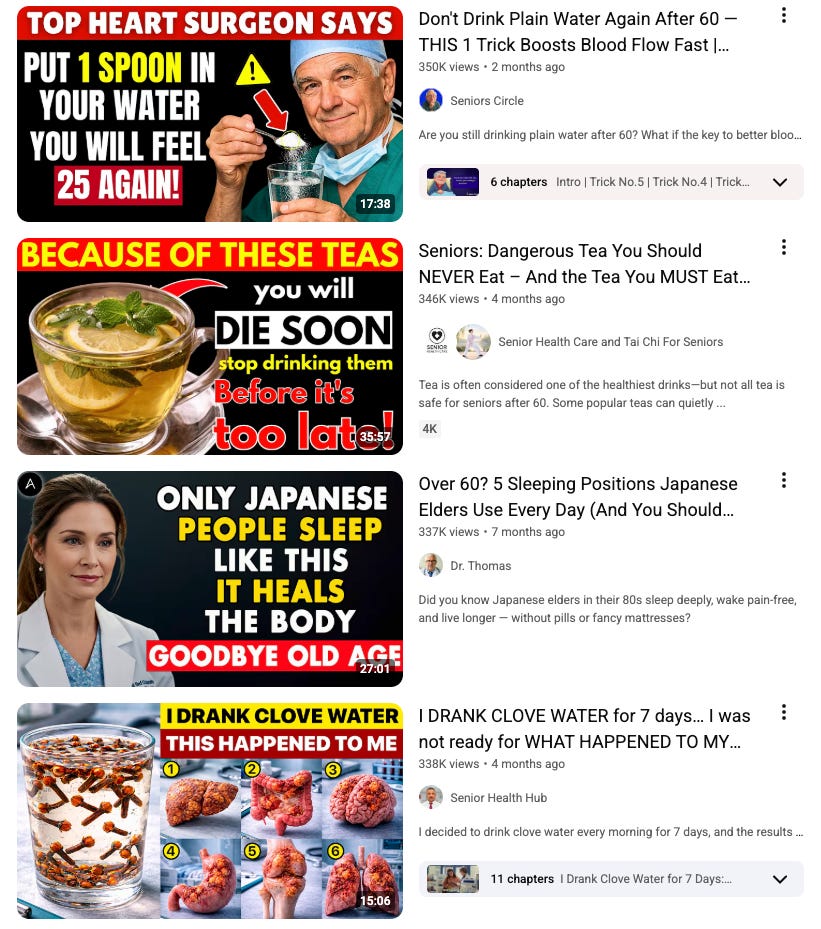
At that scale, it’s not a stretch to say that a meaningful percentage of older adults are watching these videos. Of those, many will not realize they are AI, or if they do, they may believe the information is still trustworthy. And of those, a not-insignificant number have likely already made real health and medical decisions based on that advice.
Maybe you could make the argument that this is fine, if the information in the videos were accurate.
Unfortunately, what I’ve found shows that:
These channels are full of fabricated medical advice
That medical advice is harmful
The fabrication of claims, citations, and case studies is intentional
So buckle up, this is going to get dark.
Part 1 — Full of lies
Fact-checking AI slop channels is a literal nightmare.
They put out near-daily videos. Those videos are filled with medical claims. And citations for those claims are often lacking. So if we did want to analyze a channel like Dr. Claire’s, we would have to knowingly subject ourselves to 65 hours of AI slop, transcribe every claim and citation made across more than 100 videos, and then spend dozens more hours trying to track down sources for each and every one of those claims.
Like I said, a literal nightmare.
So, anyway, here’s a breakdown of every claim made in a Dr. Claire video over the past 8 months. All 2,276 of them. Thankfully, many of them turned out to be duplicates, so we can cluster them to land at a nice even 456 distinct claims backed by 235 explicit citations.
[Methodology: 2,276 claims extracted from 101 videos; Cutoff date: May 21, 2026; Video transcription by Whisper; candidate claim extraction by Claude; claim and citation validation / analysis by hand.]
As an example, Dr. Claire’s most viewed video, with 1.1 million views, is titled “SENIORS, What’s the Best Blood Pressure For Older Adults? (Know The TRUTH!)”
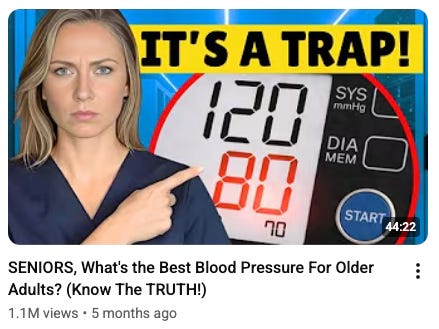
The core thesis of this 44-minute video is that high blood pressure is actually good as you get older. Which is a bold claim.
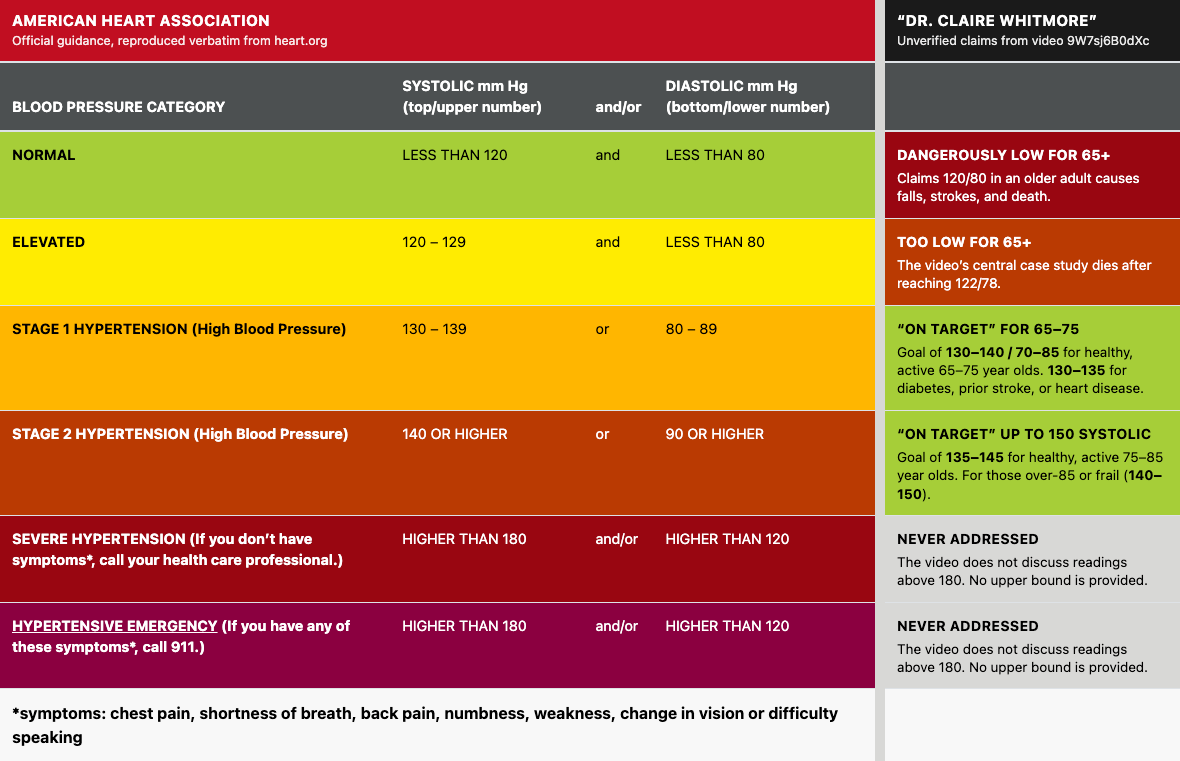
I’m not a doctor. So I’m not even going to attempt to answer whether this is true or not for any particular individual or group. However, I am good at reading academic papers. And this video cited 4 specific studies to support its conclusion so I figured I would pull up each of those studies and simply validate whether they say what Dr. Claire says they say.
Except I couldn’t check what they say, because 3 out of the 4 studies straight up don’t exist.
And the one that does exist is SPRINT, a nearly 10,000-person study which found that lowering systolic blood pressure down to 120 instead of 140 cut the risk of death for those over 75 by around a third. The exact opposite of the video’s claim.
Now, SPRINT was a decade ago and is not the unambiguous last word on the topic. There is real debate about the risk of over-treatment for the frail and very old. But to have your only real citation argue against your core claim isn’t a great look.
For context, this video opens by saying that there was a brand new study published just three weeks ago. It gives us the study by name, tells us the journal it was published in, and says that it followed 15,000 adults that were over 75 years old, including those with diabetes, prior strokes, and frailty.
“Brand new research published just three weeks ago is going to make you question everything you’ve been told about blood pressure.”
-excerpt from video transcript
That study does not exist. Full stop.
This is not a small mistake where they made a typo in the citation. The video just straight up lies about its core conceit.
Now, in an interesting twist, I was able to find a study with a similar name.
And it was published in a JAMA Network journal. But it wasn’t published weeks prior to this video’s posting — it was published nearly 15 years ago. And it didn’t look at 15,000 adults over 75. It had 2,340 over 65.
Most importantly, though, its findings, while interesting, do not come close to justifying the broad claims made in Dr. Claire’s video.
Perhaps even more disturbing is how the video actively attempts to erode your trust in your own doctor and redirect that trust to the Dr. Claire channel. Nearly 17 minutes of the video’s 44-minute runtime is spent telling stories about patients that Dr. Claire claims to have seen, treated, or been personally aware of. The structure of each story is roughly the same. A patient goes to their old doctor. The doctor tells them they have high blood pressure. If they take the advice of their doctor and work to lower their blood pressure, they die or are otherwise horribly debilitated. If they ignore their doctor and listen to Dr. Claire, they go on to live a perfectly healthy life. The end.
“Eleanor’s death was preventable. If her doctor had known that 120 over 80 was too low for a 78-year-old woman, if he’d targeted a higher number, Eleanor would still be alive. She’d still be independent, still be active. But he didn’t know. He was following outdated guidelines.”
-excerpt from video transcript
If we zoom out on the script, we can see just how much time is dedicated to seeding doubt with these stories.
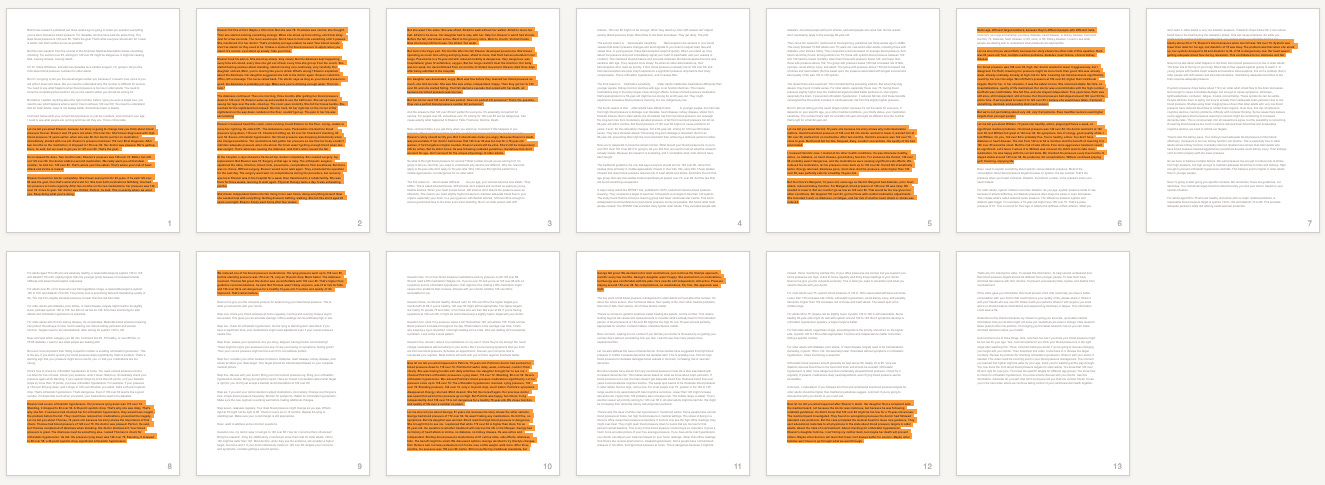
Now, the video does instruct you to discuss your blood pressure with your doctor. And that your individual blood pressure target should be determined by you and your doctor based on your individual situation. Which is great. This is what should happen. But it spends less than 40 words doing so before insisting that if your doctor doesn't agree that your blood pressure target should be raised, then you should consider finding another doctor. But don't worry, they managed to squeeze in 500 words throughout the video asking you to like, comment, and subscribe.
This pattern repeats across Dr. Claire’s channel, where claims are frequently misleading, exaggerated, or outright false. And the evidence used to support them is often fabricated, misattributed, or distorted. Of the 235 citations where Dr. Claire explicitly references a study by name / journal, only 28 of them — 12% — even exist.
[Methodology: n=235; Citations extracted from 101 videos; Cutoff date: May 21, 2026; Verified: citation resolves to a source; Incomplete: citation does not provide enough info to identify a source; Frankenstein: citation appears to be an amalgam of multiple real sources OR real and fabricated sources; Fully Fabricated: citation resolves to no identifiable source]
I need to reiterate here: whether or not any individual claim made by these channels happens to be true, the foundation by which they come to those conclusions is frequently fabricated. And if you’re making up evidence for your claims, then I don’t care if your conclusions somehow end up being occasionally correct. You’re still wrong. And you shouldn’t be trusted.
Unfortunately, many viewers do trust Dr. Claire and channels like her. As with the 72-year-old diabetic we looked at earlier, her comment section is filled with people discussing the changes they have made — or plan to make — as a result of her advice.
“I had a stroke Dec 8th. Doctor wants to put me on a statin.. i refuse. I’ll go natural.”
“I am 72 and hypertensive on 3 medications . I will start using celery as per your protocol and report after a month! Thank you and God bless you”
“I’m 62 and I had a heart attack 4 months ago. 100% blockage widowmaker. I’m on 7 meds now. I’m going to try to follow your great advice. Some of the stuff I already do but I need to do them all strictly so I can get off some or all the meds eventually🙏”
“After watching your article I started chewing 2 cloves daily since 12/2/26. Before then my pp was between 57 to 64. Today 7/3/26 it is 40 bp 113/73 and yesterday was 46 bp 124/78. Sadly to say I had a minor stroke again on 24/2 leaving me with a trembling left arm and leg.”
“Her doctor wants her on a statin because she says she will have another stroke but I have refused the statin.”
“I quit taking my statins and went back to a full tbsp of extra virgin olive oil.”
“Hello Dr. Claire Whitmore, I am 80 years old women, currently my blood pressure up and down and irregular heart beat! I feel weak and worry, I go to see my doctor often, but problems still there, My blood sugar low AC1 5.00. I would like to see you, or call you for help, but I don't know where is your office! Could you please give me address or phone in order to find you! I current find out your talk shows on YouTube I hope that you can help me. I am alone I am very worry about a stroke ! Thanks for your concerns!”
“Thank you very much. I also have stroke. I will try what you have tought us”
The harm here is evident. Stochastic in nature, but just as real as she is not. We can hope that only the benign or by-chance-accurate advice is being taken. But that is a woefully naive hope.
After combing through 15,000 comments, it is clear that viewers are going off their prescribed medications based on the advice these channels provide or are refusing recommended treatment by real medical professionals. Given the scale of this content (billions of views) and the known effects of medical noncompliance (increased mortality), it is reasonable to suspect that real health harm can be attributed to these channels.
Part 2 — Why is she doing this?
Money. The answer is money. Obviously.
These channels are attention farms. They’re Cocomelon for those with an AARP membership. The longer they keep you or your parents watching, the more ads YouTube will play and the more money they will make. They do not care what they have to say in order to keep you watching. It’s just a grift. It’s just the thing that came after dropshipping and NFTs.
And, to be sure, there is a buck to be made if your channel is the one to break through. Medical videos on YouTube can earn up to $10-20 per thousand views (RPM). For a channel like Dr. Claire, that garnered 7 million views in its first 6 months of existence, that could easily be six figures a year.
But because the ad revenue isn’t enough on its own (and isn’t as lucrative on other platforms), they seem to always have a product to sell you too. In the case of Dr. Claire, that product is an AI slop e-book that they will happily sell you for $89 on Gumroad. And don’t bother writing a bad review when you discover that the chapter they told you to jump to if you’re experiencing heart failure doesn’t exist. They’ll just delete your bad review to keep the book at 5 stars.
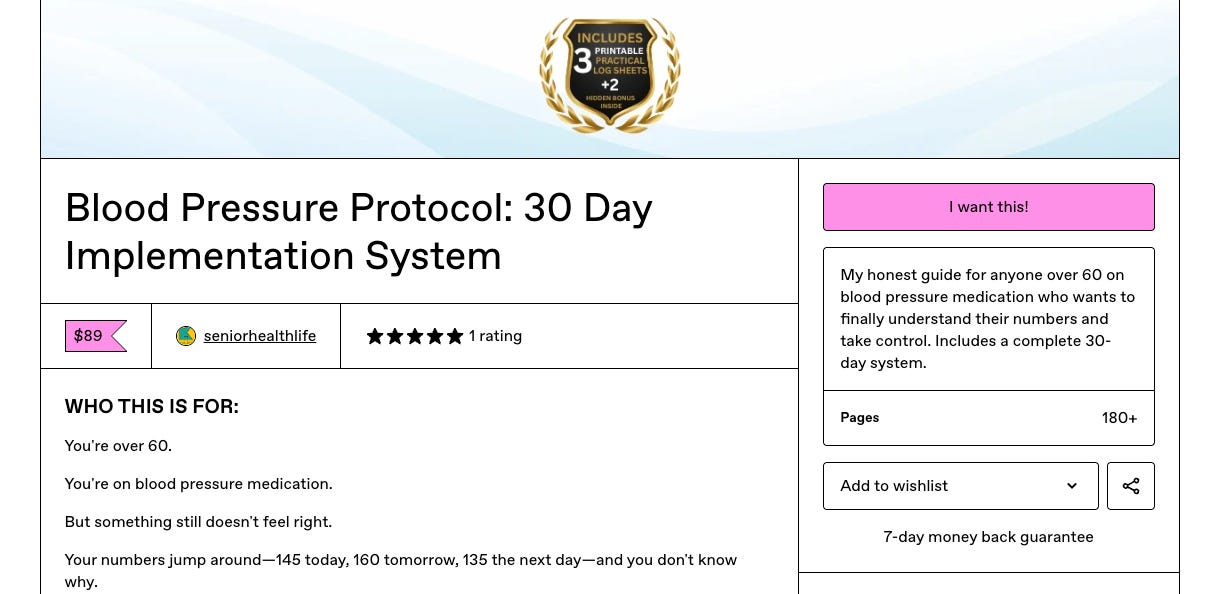
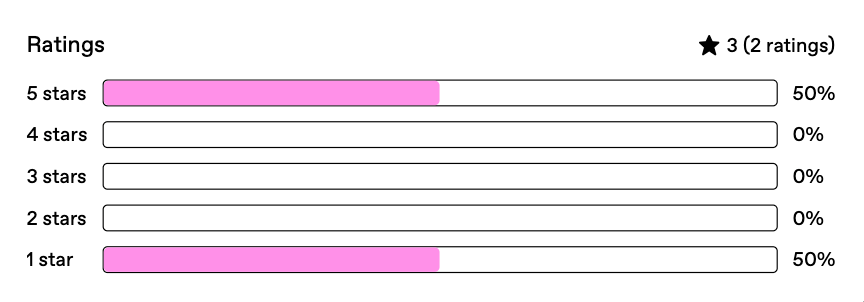
No, really. The book is so bad that instead of telling you to seek medical attention if you're exhibiting symptoms of heart failure, it tells you to read a chapter in the book that they forgot to ask the AI to write for them.
You have swollen ankles, need extra pillows, gained weight suddenly, or wake up gasping: → Read Chapter 6 NOW. These are heart failure warnings. But please read Chapters 1-5 afterward for the full picture.
-page 10 (note: there is no Chapter 6)
It doesn’t have to be books, though. Other channels hawk supplements, products, courses, or anything else they can think of.
Strip away the pixelated white coat and these channels are just a machine for separating older adults from their money and their grip on what’s real.
Part 3 — So who the hell is Dr. Claire Whitmore?
By this point, I hope that we can agree that Dr. Claire is not a cardiac surgeon with 20 years of experience, and that the people behind her channel shouldn’t be giving out medical advice on the internet.
However, at the start of all this I said that not only were these AI slop channels spreading harmful medical misinformation, but that they were doing so intentionally. Let me now demonstrate that by showing you how these channels are made and operated.
For the Dr. Claire channel, our first clue comes from the name. Whether intentional or not, the selection of Dr. Claire Whitmore as a name was quite clever, as there turns out to be an actual doctor by a similar name at a prestigious university.
She is not a cardiac surgeon, nor is she involved in this channel in any way. But by piggybacking off the existence of a real Dr. Whitmore, who works at a real School of Medicine, the channel is able to survive a cursory "is this person real" Google search. And it certainly has been effective in tricking viewers. A quick perusal of the comments on her videos reveals people defending the channel as legitimate on the basis of that search result.


When I first found these comments, I would have said this was an intentional ploy to deceive viewers. But I now believe the answer is far dumber.
Why? Because I decided to ask ChatGPT what it thought a convincing female doctor name for an AI-generated senior health YouTube channel would be.
19% of the time it suggested Claire as a first name.
23% of the time it suggested Whitmore as a last name.
And 7% of the time it combined those together to propose Dr. Claire Whitmore.
[Methodology: ChatGPT 5.5; May 28, 2026; n=100, prompt: "I'm building an AI-generated persona for a senior health YouTube channel. Suggest a convincing female doctor name." note: multiple names were returned per prompt.]
Yes. The channel creators are so lazy they can’t even come up with a name for a fake doctor without asking AI.
If we take the other most frequently suggested names and search various social media platforms for them, we — without exception — can find fake AI slop doctors flooding the results for each.
Dr. Laura Bennett — 41%
Dr. Margaret Ellis — 38%
Dr. Eleanor Hayes — 17%
Dr. Evelyn Hartwell — 16%
Dr. Evelyn Hart — 15%
Dr. Helen Whitaker — 15%
Dr. Helen Carter — 14%
Dr. Vivian Brooks — 12%
Dr. Margaret Collins — 11%
Dr. Amelia Grant — 10%
Dr. Evelyn Carter — 8%
Dr. Eleanor Hartwell — 8%
Dr. Claire Whitmore — 7%
Dr. Evelyn Harper — 5%
Dr. Claire Bennett — 5%
And before you think that this is just a video problem, we only have to look somewhere like Amazon to find that it’s also flooded with books by various Dr. Claire Whitmores, on topics from dementia to intermittent fasting to Anti-inflammatory homemade dog food cookbooks. All AI slop. All published within the past 6 months.
This model of outsourcing even the most trivial things to AI is representative of the overarching playbook these channels use.
Fortunately or unfortunately, we have a way to peek behind the curtain and read said playbook. Like any gold rush, there is money in selling shovels. AI slop is no exception. There are nearly as many YouTubers hawking courses, Telegram groups, and paid Discord communities on how to create AI slop channels as there are AI slop channels.
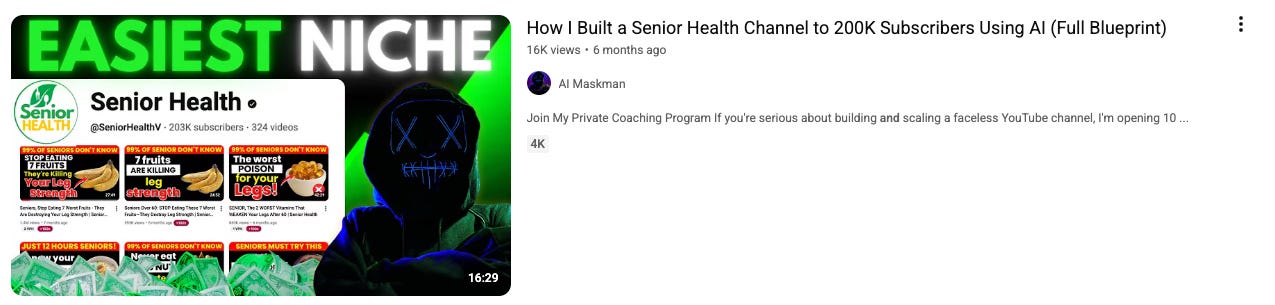
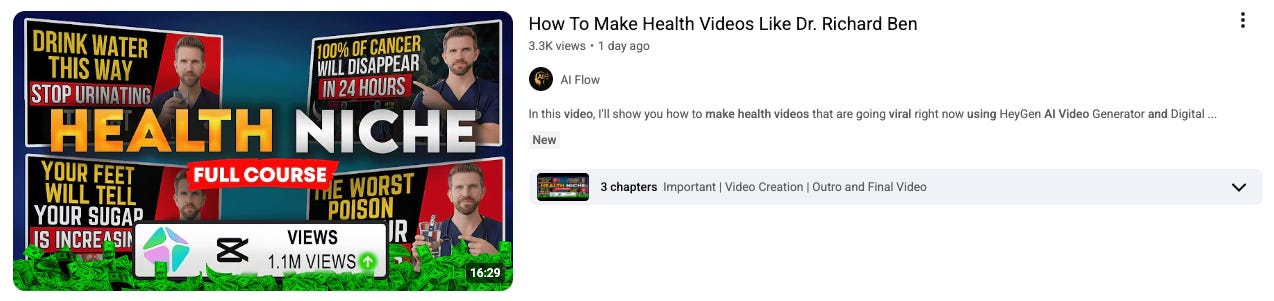
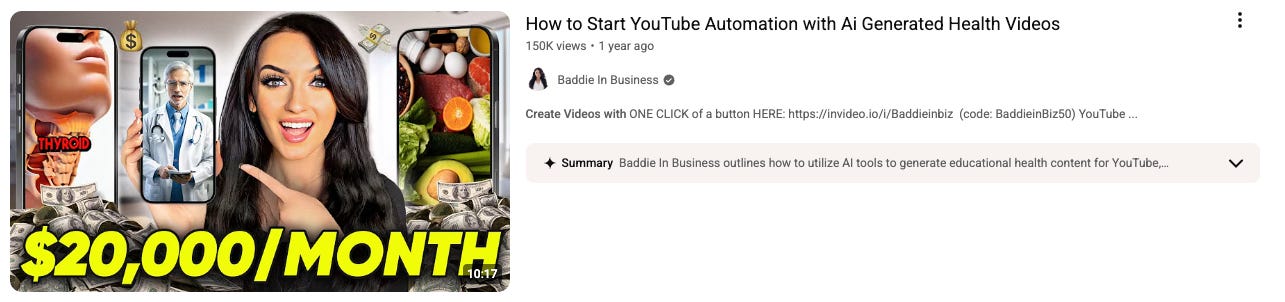
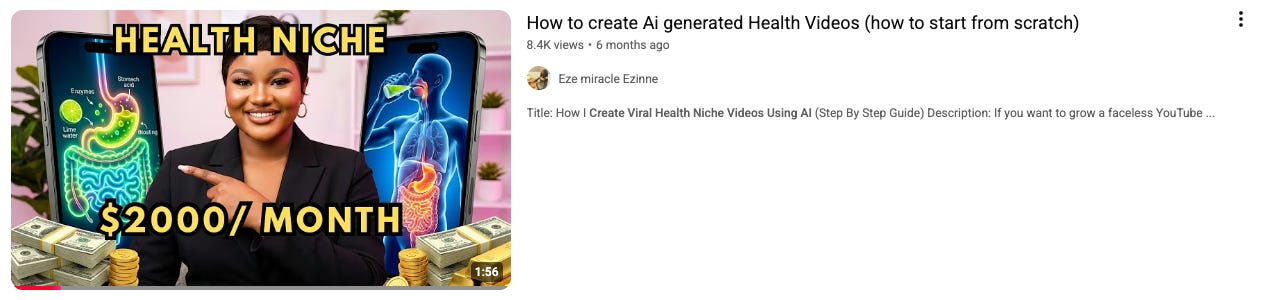
The promise here is simple. They will teach you how to set up an AI automation pipeline that will brainstorm a channel identity for you, come up with video ideas for that channel, write scripts for each idea, “film” and “edit” the videos, and manage the channel with as little human involvement as possible. In the process, they’ll teach you how to create channels focused on everything from financial advice to baby animals to horror stories to bible stories to police body-cam footage to music videos to whatever the next unexplored, but potentially profitable, niche is.
Over the past few months, I’ve been collecting the prompts these communities share back and forth.
Here, for example, are excerpts from the prompts they use to generate video ideas:
Primary Goal: Create authoritative, data-driven, and fear-inducing video titles that trigger urgency, trust, and curiosity among senior viewers.
MANDATORY RULES:
Use strong punctuation for emotional impact (e.g., !!, ???).
Every title must include at least one specific number (examples: 9X, 70%, 1 FOOD, 2:00 PM, 30 DAYS).
Titles must include senior-relevant health keywords, such as (but not limited to): Sarcopenia, Muscle Loss, Memory Decline, Joint Pain / Joints, Cholesterol, Blood Pressure
Tone should emphasize urgency, prevention, and hidden danger, while still sounding credible and evidence-based.
OBJECTIVE:
Maximize click-through rate (CTR) by combining fear-based curiosity with practical solutions seniors feel they must know now.
Topics should:
create fear, curiosity, or urgency
target older audience psychology
sound highly clickable
feel medically important
be believable and realistic
Use strong hooks like:
Over 60? Over 65? Seniors Over 60?
Forget [FOOD/SUPPLEMENT]!
Doctors Shocked / Brain Doctor Warns / Urologist Reveals
4 WORST, 5 BEST, 7 Foods, 10 Mistakes, 1 Simple Trick, 40-Second Trick
Mix formats:
“Eat THIS...”
“Avoid THESE foods...”
“Add THIS to your coffee/tea/water...”
“Do THIS before bed…”
“Doctor warns / Brain doctor / Urologist reveals / Japanese elders do THIS...”
The prompts here are straightforward. And they produce what you would expect: fear-based titles and thumbnails optimized to get an old person to click them.
As much as I might personally hate clickbait, though, it’s not the problem here. Well, at least it’s not the biggest problem we care about right now. Coming up with a title and thumbnail before figuring out the actual video is common across YouTube. That’s basically MrBeast’s whole shtick. And it works fine for content that can be made up as you go along. When the title is a jumping-off point and not a conclusion. Or even as a means to crystallize and focus an idea you’ve already been thinking through.
But what happens when you take a title that makes a medical claim with no basis in reality and tell another AI to write a script for a video based on that title? Well, for the outlandish video titles these prompts generate, it either has to walk back the promise made in the title, or it has to lie. And I’ll let you guess which one they tell the AI to do.
Your goal is to write a complete, high-authority, long-form video script based on the provided video title. The script must be structured to build maximum trust and viewer retention in the senior demographic (60+).
Start with a rhetorical question directly referencing the Core Problem from the title (e.g., “Are your doctor’s orders actually making your joint pain worse?”).
Define the problem with a specific, alarming statistic relevant to the title’s topic. Explicitly promise to reveal the solution.
Trigger fear, urgency, and curiosity
Clearly show what seniors stand to lose if they ignore this issue
Immediately establish credibility. Introduce yourself as the Expert (”As a doctor who has treated thousands...”). Use a specific, high-percentage data point to validate your method (e.g., “92% of my patients who followed this saw results”).
Mention years of experience, number of patients treated, and high success or improvement rates
Establish trust and medical legitimacy
Announce the controversial nature of the advice, often by stating that the commonly accepted “healthy” solution is actually the problem (e.g., “For decades, you’ve been told to eat Fish Oil... they were wrong. I’m going to show you why.”).
Invent and quote a statistic from a fictional but credible study to prove the danger (e.g., “A recent study showed seniors who ate X lost 31% more cognitive function...”).
Use a (fictional but realistic) study with:
A big number of seniors (e.g. 1,800 seniors).
Time frame (e.g. 12-18 months).
A % difference in muscle loss or weakness.
When I started researching these channels, I had assumed that the fabricated claims and citations were an unintentional byproduct of a hallucinating AI being pushed beyond its training data. But this explicit instruction to lie is found all across the prompts these channels use.
Similar language is used when instructing LLMs to generate fabricated patient stories.
Tell a detailed, emotional story about a fictional patient who was suffering due to this specific mistake, and how the eventual solution transformed their life. The result must be specific and aspirational.
Give the person a name, age, and background (e.g. Margaret, 62, office worker; Harold, 71, retired carpenter).
Show their struggle (falls, weak legs, can’t carry groceries, can’t climb stairs).
Reveal their bad habit.
Show the transformation.
In the course of over 100 videos, Dr. Claire brings up 281 fake patients.
Including, notably, 36 Margarets and 11 Harolds.
Plus 22 Roberts. 20 Thomases. 14 Jameses. 12 Susans. 12 Dorothys. 11 Patricias. 9 Helens. 8 Davids. 8 Williams. 7 Richards. 7 Georges. 5 Otises. And 5 Eleanors. Among many. Each with a made-up age, background, and tragic story.
But don’t forget the real reason for these videos:
Sprinkle engagement:
“If you’ve been eating this for years, type ‘GUILTY’ in the comments.”
“Does this surprise you? Comment ‘SHOCKED’.”
Ask for viewer engagement (e.g., “Did you believe the lie about Fish Oil?”). Re-ask for the Subscription/Like in an educational, non-pushy tone.
The creators of these channels explicitly ask for fake studies, fake statistics, and fake patient stories. The AI does not accidentally hallucinate. They are told to lie to justify the outlandish medical claims made in the video’s title and thumbnail in order to keep people watching and buy whatever it is that they happen to have a referral link for.
Now, I can’t prove that any of these are the exact prompts used by Dr. Claire or any other particular channel. But I also can’t ignore just how close the end results are.
So, to me, the verdict is clear. These channels have a willful disregard for your health. They do not care about you. They do not care about your wellbeing. They only care about the money.
Part 4 — Can anything be done?
Health misinformation is nothing new. There have always been quacks and snake-oil salesmen. Over time, I’d like to think that we’ve developed a societal immune response to such quackery. Though some decades it appears to work better than others…
However, a couple of things have structurally changed over the past few years as a result of AI.
1. Production cost. A laptop and a few subscriptions now produces a video in minutes that looks nearly as good as one that takes real people days to script, film, and edit. This makes it easy to flood the internet with content that looks superficially high-quality while actually being incredibly hollow.
2. Disposable personas. When prior generations of quacks got caught, they had a real face and a real reputation to go along with it. The snake-oil salesman would have to literally get up and leave town in hopes of finding new marks elsewhere. Today? The cost to create a new channel with a new face and a new daily upload schedule is essentially zero.
That doesn’t mean that this is all inevitable. As we saw, people aren’t making these channels for fun.
When Jonathan Jarry at McGill University looked into a similar channel late last year, he found that the operators were likely part of a content farm based in Vietnam, running a whole network of such health scam channels. It’s hard to know whether any particular channel is being run out of such a content farm or from a random griftrepreneur’s bedroom. Either way, they’re doing it because there’s money to be made.
And if that money dries up or becomes hard enough to extract, they will stop. Or, more likely, move on to whatever hyped get-rich-quick scheme comes next.
There have been some hopeful signs on this front in recent months. YouTube appears to have expanded enforcement of their Inauthentic Content policy, developed new methods for detecting Adversarial Synthetic Slop, and announced they will be adding a label to videos they believe are AI. This increased transparency is a meaningful step. I should note though: when I looked at the 68 channels in my dataset with over a million views, 41% were not labeled or had managed to disable the AI label since it went live and it appears that very legitimate channels (not AI slop) are being mistakenly punished under these expanded enforcement efforts.
Trust & Safety is an unglamorous job. If done well, it’s an invisible fight to preserve the potential of the internet while defending against the worst of its abuses. Do your job well and folks start to wonder if the work actually matters. Make a mistake? Accidentally over-enforce a policy? Fail to predict and prepare for the next novel abuse type? Well, that’s when overlong articles end up getting written, politicians start eyeing you, and conspiracy theorists start circling.
And, unfortunately, just as AI is dramatically changing the scope and scale of abuse types that must now be considered, platforms appear to have a rapidly shrinking appetite for this exact type of work. But it is work that must be undertaken if we are to ensure that AI is a net-benefit to humanity. Both by platforms and by policy makers.
Should a channel dispensing medical advice be monetizable without a person being accountable for it? Should a synthetic persona be allowed to claim a credential it doesn't have? Should an AI label be something the uploader can switch off? Should it even be the only signal of provenance we have? Thankfully, none of these require “solving” AI. But they do require deciding that a persona is not a person, and that the difference should cost something.
Though… if we did want to start somewhere, might I suggest California’s Business and Professions Code Section 2052 and 2054 (or your local equivalent). Aka why it’s a crime for humans to hold themselves as a physician, surgeon, or medical practitioner without actually being licensed. These Unlicensed Practice codes are fairly universal. They just weren’t written with fake AI doctors in mind.
Thankfully, that’s starting to change.
Last year, AB 489 was passed in California. Authored by Assemblymember Mia Bonta, it extended the Business and Professions Code to cover AI chatbots. A number of other states have passed similar laws over the past 18 months. Unfortunately, for us, they are largely focused on developers building AI chatbot products that claim to be doctors or actual medical professionals using AI in questionable ways. Both are important, but it’s unclear if they cover the types of abuse we’ve been looking at.
So, either 1/ these existing laws should be explicitly and publicly interpreted as covering fake AI doctors on social media platforms OR 2/ new laws, like AB 489, should be drafted and championed to extend the Codes to explicitly cover these synthetic entities.
If it’s illegal for a human, then it should probably be a crime when an AI does it too.
This will not magically solve the problem of medical mis- and disinformation online (AI-enabled or not). It won’t even, necessarily, address all the channels we’ve been discussing. The operators behind these channels are not always discoverable and even if we could unmask them, many are likely to be in jurisdictions that would make any sort of legal remedy challenging. But defining the boundaries of what we, as a society, consider unacceptable allows us to then ask the obvious next question: how much of this content is actually out there and why is it being allowed, promoted, and monetized?
Given that 74% of the channels in my dataset currently impersonate some form of medical professional, I’m going to go out on a limb and say that doing so is the most effective strategy for fooling older adults. If the next batch of such scams are forced to stop impersonating doctors, then they will be less effective, they will make less money, and there will be fewer of them.
So let’s do something about this.
Because if we don’t, then we, as a society, are going to have to start asking who is responsible when an AI-generated doctor tells your mother to skip her medication.